Introduction
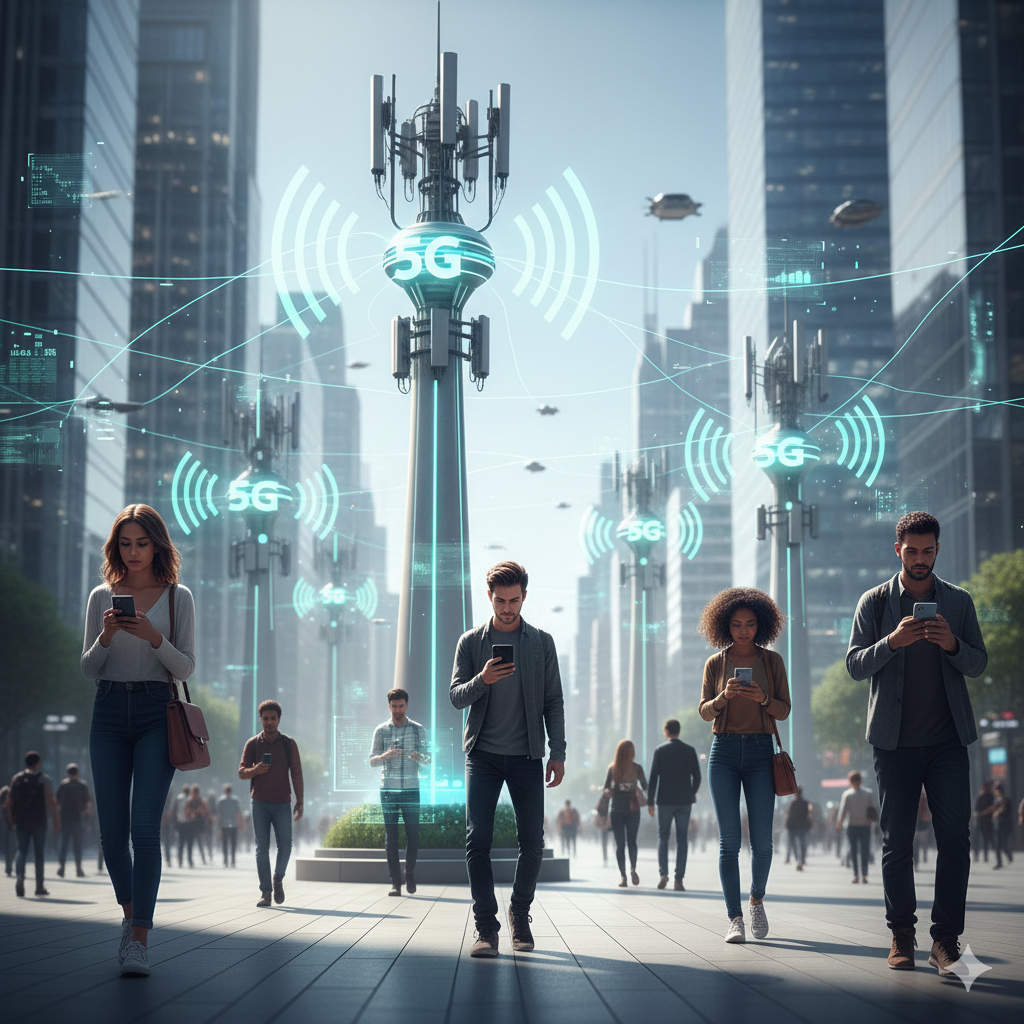
5G internet speed is changing how we browse, stream, and connect online. Compared to older networks, 5G offers faster downloads, lower delays, and more stable connections. As a result, everyday digital activities feel smoother and more responsive. In this guide, you will learn exactly how 5G impacts internet speed and what it means for real-world use.
Table of Contents
What Is 5G Technology?
How 5G Improves Download and Upload Speed
Latency Reduction and Real-Time Performance
Network Capacity and Congestion Handling
5G vs 4G Speed Comparison
Impact on Streaming and Online Gaming
Business and Smart Device Connectivity
What Is 5G Technology?
5G is the fifth generation of mobile network technology. It is designed to deliver higher data rates, ultra-low latency, and massive device connectivity. Moreover, it uses advanced radio frequencies and smarter antennas to transmit data more efficiently than 4G.
Unlike previous generations, 5G supports both sub-6GHz and millimeter-wave bands. Therefore, users can experience faster and more reliable connections, even in crowded areas.
How 5G Improves Download and Upload Speed
One of the biggest benefits of 5G is its dramatic improvement in speed. Downloading large files, watching high-resolution videos, and uploading content now take much less time.
In addition, 5G allows wider bandwidth channels. As a result, data moves faster between your device and the network, leading to quicker response times and smoother browsing.
Speed Comparison Table
| Network Type | Average Download Speed | Average Upload Speed | Typical Latency |
|---|---|---|---|
| 4G LTE | 20–50 Mbps | 5–15 Mbps | 30–50 ms |
| 5G Sub-6 | 100–400 Mbps | 50–100 Mbps | 10–20 ms |
| 5G mmWave | 1–3 Gbps | 200–500 Mbps | 1–10 ms |
This table clearly shows how 5G outperforms older networks in both speed and responsiveness.
Latency Reduction and Real-Time Performance
Latency refers to the delay between sending and receiving data. With 5G, latency is significantly lower. Therefore, actions like video calls, online gaming, and cloud applications feel almost instant.
Moreover, reduced latency supports real-time technologies such as virtual reality and remote surgery. This makes 5G not just faster, but also smarter and more reliable.
Network Capacity and Congestion Handling
5G can handle many more devices at the same time. In busy areas, older networks often slow down due to congestion. However, 5G uses advanced beamforming and network slicing.
As a result, each user gets a more stable connection, even during peak hours. This means consistent 5G internet speed in stadiums, malls, and city centers.
5G vs 4G Speed Comparison
When comparing 5G and 4G, the difference is clear. 5G offers multi-gigabit speeds, while 4G usually stays below 100 Mbps. Therefore, tasks that once took minutes now take seconds.
In addition, 5G provides better performance for high-definition streaming and large file transfers. This makes it ideal for both personal and professional use.
Impact on Streaming and Online Gaming
Streaming platforms now support 4K and even 8K content. With 5G, buffering becomes rare. Moreover, adaptive streaming works more smoothly due to stable bandwidth.
For gamers, lower latency means faster response times. As a result, competitive online gaming becomes more precise and enjoyable.
Business and Smart Device Connectivity
Businesses rely on fast and reliable internet for cloud computing and video conferencing. 5G improves productivity by offering consistent high-speed connections.
Furthermore, smart devices and IoT systems benefit from real-time data transfer. Therefore, smart homes, autonomous vehicles, and connected factories operate more efficiently.
Conclusion
The impact of 5G on internet speed is powerful and far-reaching. It delivers faster downloads, lower latency, and better network stability. As a result, users enjoy seamless streaming, responsive gaming, and reliable business connectivity. With continued expansion, 5G internet speed will shape the future of digital communication and smart technology.